Wednesday, March 20, 2013

The fate of Commodity Exports: Key Determinants

 
Commodities exports are highly susceptible to sharp changes in demand and supply. Spiky price changes remain a constant feature since the market is hardly in control of far reaching socio-economic and political developments in the producing and consuming nations. Real or perceived changes in demand and supply sources could lead to sudden rise or fall in commodity prices. Threats of unrests in the Middle East, which supplies up to 30 percent in global crude oil; or prospects of an economic slowdown in the US, China and Europe for example which are the major crude oil consumers, could exert dramatic upward or downward pressure on the price of crude oil. The same is the true for most other commodity exports and interestingly, the timing or scale of these influential market factors are ever difficult to direct.

In July 2011, Consensus Economics, a leading macro-economic analysis firm carried out a survey (‘Factors Affecting Commodity Prices’)which asked experts to compare and rate the differing degrees of sensitivity with which the prices of different commodities respond to a range of influences at every point in time in the global market. The rating was on a scale of 0-10, with 0 indicating ‘no influence’ and 10 signifying ‘very strong influence’. The outcome of the survey shows some of the key factors that determine the price of key commodities in the global market.

In this survey, most of the respondents identified ‘Demand/business cycle’ as an influential factor in the price of several commodities, with rating averaging about 6.8 out of 10 in total. For aluminum, copper, steel and palladium, respondents ranked this particular determinant 8 out of 10. The influence of Government trade policies, was expects year end 2012 growth of around .5 percent, its weakest growth in about five years.

Highly export dependent, the Chinese economy has been hit by troubles in the euro zone, the US and others, which has dampened exports and investment in flows. The company is also struggling with a bust in its hitherto bubbling property market.For the net exporters, while the prices of some of the most essential commodities, especially agricultural and energy products have remained relatively favourable since the euro zone debt crisis, the magic has not been due to a strengthening in demand but to production and supply fears and the activities of speculators. These ‘satisfactory’ price level (at around $100 per barrel) explain, for example, why OPEC has left crude oil production figures unchanged since the beginning of the year.

But for how long will the ‘satisfactory’ price levels of these and other commodities be sustained, given the slowing economic fortunes In   China?  For commodity export dependent countries, any bad news from their biggest market, China, is indeed bad news.

Experts opine that China will be the main determining factor of future of commodity demand and price; first, for the size f the economy which is now the second largest after the United States; and for its stage of socio-economic development which creates strong demand for commodities. Also, the sheer size of its population-about 1.3 billion people with a rapidly growing middle class makes it the key consumption market to watch.

A report published n the wall street journal (“As China Goes, So Go commodities’ by Liam Pleven; December 14, 2011) places the direction of global commodities demand and prices at the door steps of a China. “You want to know where the global commodities markets are heading in the coming years? Then it’s probably best that you remember a single word: China”

According to the report, no single factor is likely to have a more far-reaching impact on commodities markets over the next few years than the direction of the Chinese economy. If China maintains its traditional full speed growth, demand for the prices of commodities will remain bullish. If the current marginal slowdown is sustained, say at between 7-9 percent, commodities will also experience relative market stability. But if the Chinese economy experiences a hard landing, say, to the region of 4-5 percent, so will the commodities market, Particularly vulnerable are commodities highly consumed by China, including crude oil, copper, steel, coal, among others. 

more likely scenarios in the view of most experts is a moderation in the economic expansion of China, rather than a hard landing, which is good news for commodity exporters.

Another good news for African commodity exporters is that several other ‘Chinas’ are in the offing. Emerging markets such as India, Brazil, Indonesia, Russia and Turkey have the potential, like China, to boost global demand for commodities in the coming years. 

Other potential factors that could determine the future of commodity market include the outlook for technological evolutions, including bio-fuel technology; developments in financial markets; new investments in commodities production; exchange rates dynamics (especially in relation to the US dollar); growth in global population, employments in major commodity export zones; natural factors including climate change and its impacts, among others.

Culled from Zenith economic quarterly July 2012 and written by Eunice Sampson

African Commodity Export profile

While the African continent is saturated with tapped and untapped natural resources, oil is today its leading export commodity. In 1956, Nigeria’s Niger Delta
(Oloibiri, in today’s Bayelsa State)became the first place oil was drilled in commercial quantity in Africa by the Anglo-Dutch company, Shell.

Crude oil has since remained Africa’s biggest commodity export with the continent holding 9.6 percent of total global reserves. Five countries – Libya, Nigeria, Angola, Algeria and Sudan control 90 percent of the continent’s oil reserve. Libya and Nigeria control over 60 percent of this, and account for 3.3 and 2.8 percent respectively, of the global reserve, according to a recent African Development Bank report. The same report also estimates that Africa’s reserve of crude oil rose from 53.3 billion barrels in 1980 to 117 billion barrels in 2005 and 127.7 billion barrels in 2009. New oil discoveries are still being made in the continent, with the latest in Ghana.

Africa is also a major exporter of gold, accounting for up to 30 percent of total global production of the precious metal. South Africa is the largest gold exporters in the continent add among the top three in the world Ghana is the continent’s second largest gold producer. Other major exporters include Zimbabwe, Tanzania, Mali, among others.

Diamond is another key commodity export from Africa. There are 10 major diamond producing nations in Africa, including Botswana, Democratic Republic of Congo, South Africa, Angola, Namibia and Ghana. Botswana is Africa’s biggest producer in the global diamond industry valued at an estimated $158bn per annum.

Also, Cocoa is another commodity export where Africa’s excels. Ivory Coast, Ghana and Nigeria are the biggest exporters in the continent. Ivory Coast is the world’s largest cocoa exporter, accounting for about 30-40 percent of the world market. The three West African countries above are ranked among the top five global producers and exporters of cocoa, a thriving commodity that has become treasured around the world especially for the manufacture of chocolate, pastries and other highly sought after consumables.

Uranium is yet another major export commodity from the continent, with Namibia and Niger Republic as the continent’s biggest producers and occupying the 5th and 6th positions in the list of the world’s biggest exporters, according to the world Nuclear Association.

So much controversy surrounds the management of proceeds from African natural resources. Agitations for resource control and more equitable distribution of earnings from commodity exports have resulted in civil wars and socio-political unrests.

These bloodsheds have earned Africa’s vast natural wealth the derogatory description of natural resource curse’.

However, several African economies are making progress in changing this unpleasant perception with some significant improvements in the management of these resources. In the last decade, a good number of them have leveraged on this natural capital to achieve strong, uninterrupted growth, resilient in the face of severe global recessions. Improving production capacities at home and favourable prices of their commodities in global markets have helped commodities exporters to build much needed socio-economic infrastructure and nurture their bourgeoning democratic processes. Though they are also often set back by price slumps, some of them are now better placed to translate their robust export earnings o strong economic growth.

While questions persist on how far Africa’s improving economic fortune has helped in poverty alleviation, the continent at least now has greater economic prospects. For those that succeed in entrenching visionary, transparent and purposeful leadership, strong economic advancement sustained over the last decade could signal the beginning of greater things to come.

Culled from Zenith economic quarterly July 2012 and written by Eunice Sampson

Recession Fears and Africa’s Commodity Export: What Lies Ahead?

A
frica ‘s massive natural resource is indeed a great blessing; but one that has come with enormous challenges, Inarguably the most endowed continent in raw materials, most African countries depend on primary commodities for up to 70 percent of their total exports. This exposes them to the volatile price movements that characterize commodity markets, worst during periods of global economic recessions which unfortunately have become a five yearly affair.

The irrepressible price volatility in global commodities market is often beyond control of both the producers and consumers. Periods of price bubbles and false sense of abundance, followed swiftly by periods of price slumps and fiscal shocks- these have been the rollercoaster experience of several commodity dependent economies. Unfortunately, by their nature, the scale and timing of commodity price movements are difficult to predict.

As another global recession looms, this time triggered mostly by the euro zone dept crisis, the direction of the commodity market remains largely uncertain. And in the face of this uncertainty, African economies are particularly vulnerable. Unpredictable, sharp price movements of these exports constitute a menace to policy makers in their quest for fiscal and monetary stability. The external environment is constantly being scanned; and majorly consuming nations watched keenly for signs of positive economic development that would bode well for commodities demand and prices.

Worse still are the single commodity dependent countries that are left without safety nets anytime there is a crash in the price of their single export. These countries are the worst victims of the market dumping and production subsidy activities of advance economies.

While some African countries have made good progress in breaking the single commodity export jinx, many are yet to attain the level of industrialization required to export finished products, Global commodities price volatility will therefore, for a long time remain a concern for Africa. So, as another global downturn looms, the question is; what does the future hold for African commodity export?

Culled from Zenith economic quarterly July 2012 and written by Eunice Sampson

Monday, March 11, 2013

Abuja Exchange: FG sets one-year transformation target

The Federal Government has commenced the process of transforming the Abuja Securities and Commodity Exchange into a first-class commodity exchange, as part of the Federal Ministry of Trade and Investment’s Nigerian Industrial Revolution Plan.

Accordingly, it has set a one-year transformation target, saying that process will be completed in the next 12 months.

The Managing Director, ASCE, Mr. Yusuf Abdurrahim, stated this during a stakeholders’ sensitisation workshop on the revitalisation of the Exchange in Abuja.

 He said a new bill for the establishment of the Nigerian Independent Ware House Regulatory Agency would soon be sent to the National Assembly, in furtherance of the transformation.

Abdurrahim noted that the Minister of Trade and Investment, Mr. Olusegun Aganga, had already initiated reforms aimed at making the Exchange a world class institution, in line with the Transformation Agenda of President Goodluck  Jonathan’s  administration.

He said, “The programme we have just concluded is another round of sensitisation where we brought together stakeholders in the Commodity Exchange Project to continue to discuss the various building blocks of a functional Commodity Exchange. This includes a Ware House Receipt Bill, which we discussed extensively during the sensitisation workshop. We have drawn experiences from our local practice and that of Ethiopia. Probably, this might be the last discussion on the Ware House Receipt Bill before it goes to the National Assembly.

“The Commodity Exchange is a very important infrastructure for agricultural transformation, as well as looking into a transparent market for solid minerals and energy sectors. Already, the Minister of Trade and Investment, Mr. Olusegun Aganga, has initiated some reforms and he is working hard to make the Abuja Securities and Commodity Exchange as viable, vibrant, and effective as possible so that it can serve the needs of the Nigerian economy very efficiently.”

Speaking at the event, the Permanent Secretary, Federal Ministry of Trade and Investment, Mr. Dauda Kigbu, said that the development of the Ware House Receipt System would boost the operations of the Abuja Securities and Commodity Exchange and also help farmers overcome the problem of post-harvest loss.

He said, “The Ware House Receipt System is a basic infrastructure that will improve the operations of the Abuja Securities and Commodity Exchange. A WHR system enables farmers to use their stored commodities to secure credit from banks and other financial institutions. Storing their commodities in standard warehouses will enable them to avoid post-harvest losses and defer sales till the price of their commodities appreciates.”

http://www.punchng.com/business/capital-market/abuja-exchange-fg-sets-one-year-transformation-target/

Wednesday, March 6, 2013

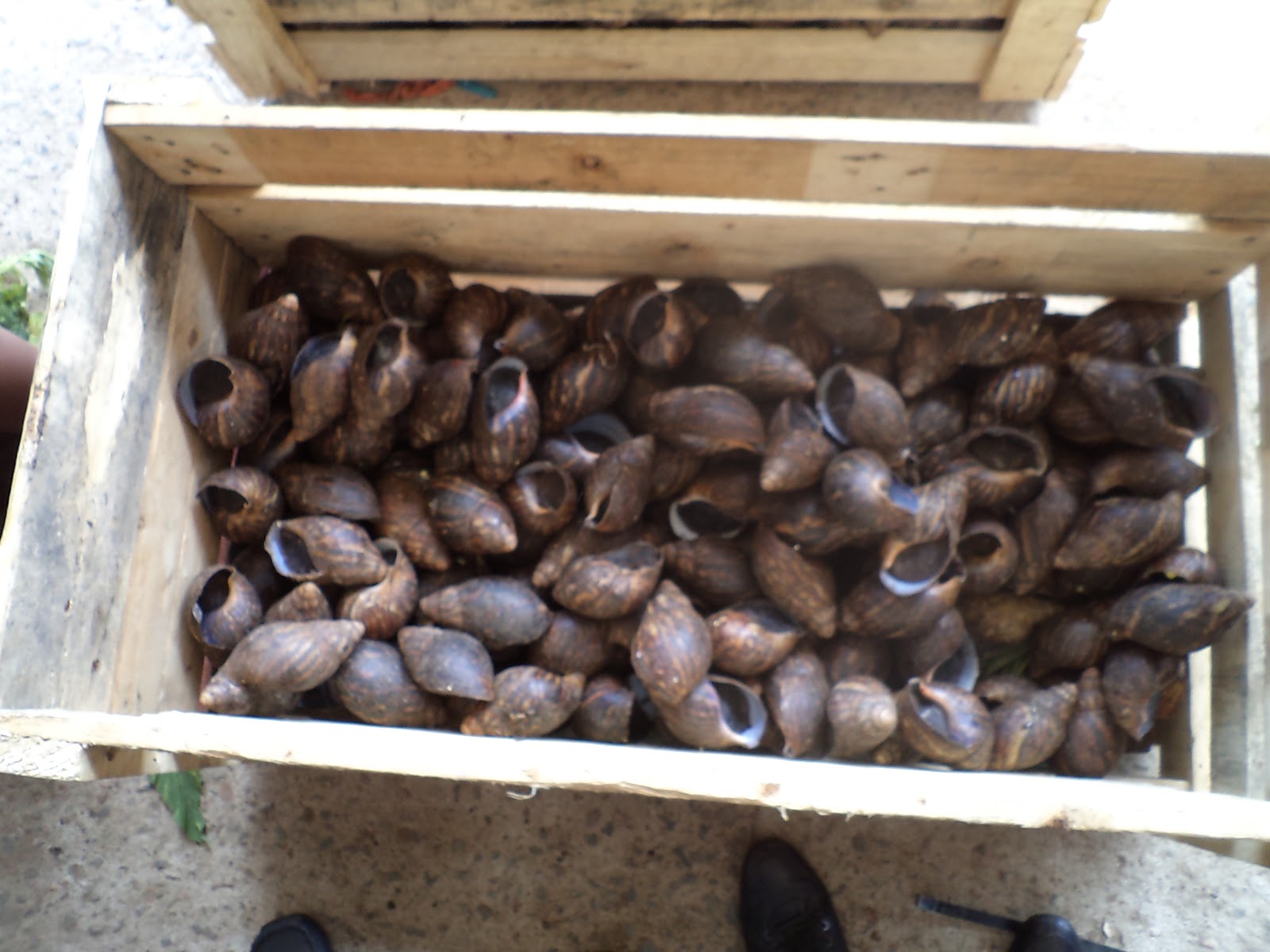
URGENTLY NEEDED: GIANT AFRICAN SNAILS

We are urgently in need of VERY LARGE QUANTITY OF SNAILS from suppliers all over Nigeria. Our specifications, payment terms, pricing and other terms and conditions are as follows:

Specifications: 
a. Size: 10-15cm length
b. Weight: 0.4kg minimum
Ex Lagos Price: N230 Per Life Snail depending on the average weight of the snail
Minimum Quantity: 3,000 Pieces Per Week
Payment Method: Cash On Delivery.
Delivery Duration: 5-7days after signing of contracts
Payment Terms: Payment to be made within 24hours after delivery and confirmation of size and quantity of life Snails.
Delivery Destination: Lagos Airport
Contact Details: Interested local supplier or exporters should contact us via info@3timpex.com and +234 803 6522 946.

Friday, March 1, 2013

URGENTLY NEEDED: ZINC ORE SUPPLY

We are urgently in need of VERY LARGE QUANTITY OF ZINC ORE from suppliers all over Nigeria. Our specifications, payment terms, pricing and other terms and conditions are as follows: 
Specifications:
a. Purity: 40% and above
b. Moisture: 0.5% Max
c. Size: 0-100mm Max
Minimum Quantity: 30MT
Price: 40-44% is N1050 per 1% (i.e if purity is 40%, then unit price will be 40 x 1050 =N42,000/MT); 45 and above is N1050 per 1%.
Payment Method: Cash On Delivery. 
Payment Terms: 50% Payment to be made (based on 40% purity) within 1 working day after product arrival and the balance will be paid after Eyeview Inspection report.
Delivery Destination: Apapa Area of Lagos

Contact Details: Interested suppliers should contact us via info@3timpex.com and +234 803 6522 946.